


BPC-157 (10mg): Pentadecapeptide Tissue-Repair Research Compound
BPC-157 is a synthetic pentadecapeptide, a chain of fifteen amino acids (GEPPPGKPADDAGLV) that corresponds to a partial sequence of a protective protein first isolated from human gastric juice. The name stands for Body Protection Compound. First described in the early 1990s by a research group in Zagreb, it has since become one of the most widely studied repair peptides in preclinical science.
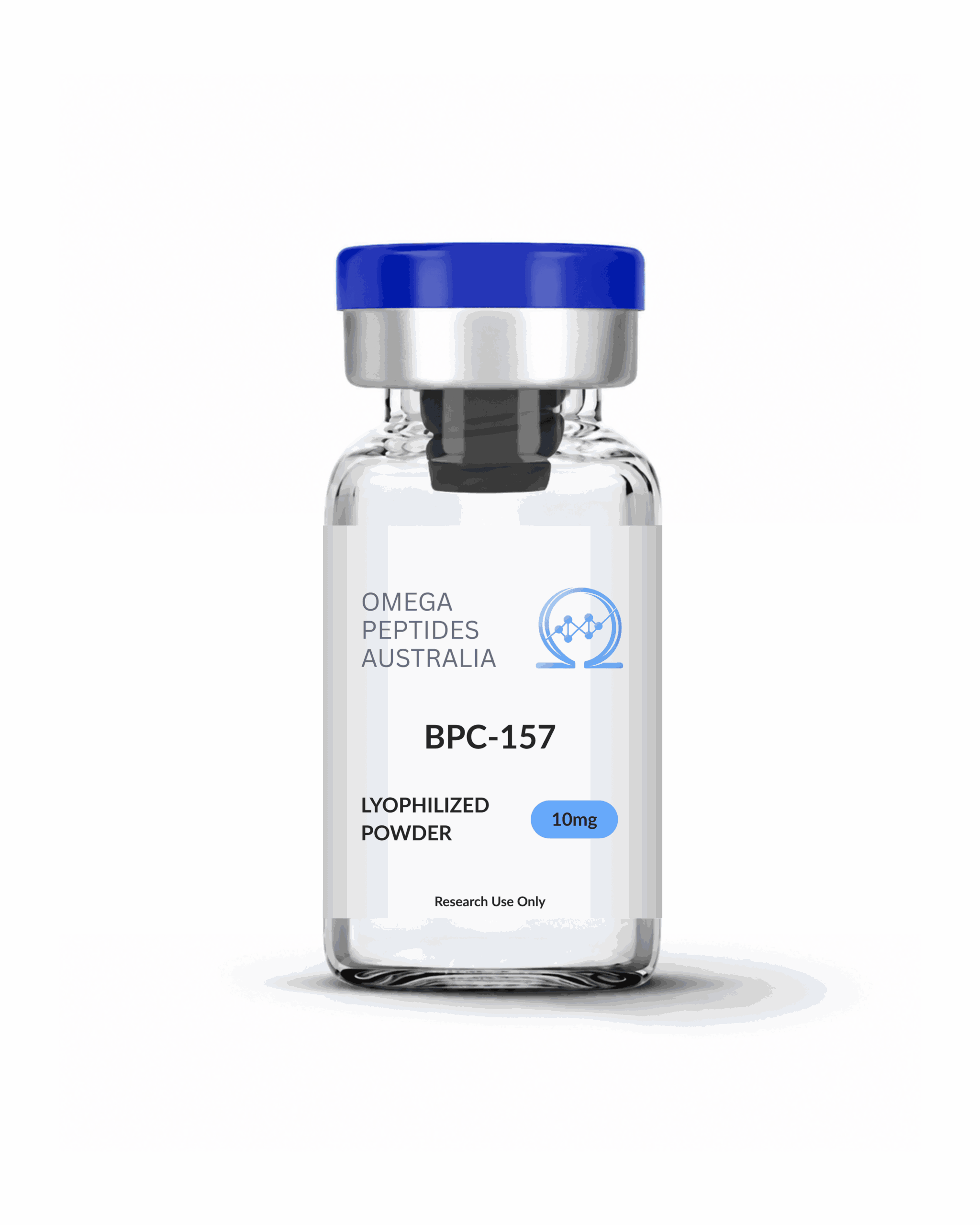
Omega Peptides Australia supplies it as a lyophilised powder in a sealed sterile 10mg vial, held in Australian stock with same-day dispatch on orders placed before 12pm. The current batch (#199765) was tested by Janoshik Analytical on 9 July 2026 at 99.66% purity by HPLC, and every certificate is published in our COA library.
Key research areas
- Tendon and ligament repair. Rodent models of Achilles tendon transection, ligament injury and tendon-to-bone healing, with increased fibroblast migration through FAK-paxillin signalling proposed as the mechanism.
- Muscle recovery. Crush injury, muscle transection and corticosteroid-impaired healing models, measuring functional recovery, fibre regeneration and reduced fibrosis.
- Gastrointestinal protection. The peptide’s original research area, spanning ulcer, fistula, anastomosis, NSAID-lesion and inflammatory bowel disease models. Its stability in gastric juice makes oral administration common in these designs.
- Angiogenesis and blood flow. New blood-vessel formation and recovery of blood flow after vessel occlusion, linked to nitric-oxide synthase activity and VEGFR2 activation in endothelial cells.
- Neuroprotection. Peripheral nerve transection, traumatic brain injury and spinal-cord compression models, plus interactions with the dopamine and serotonin systems.
- Organ protection. Liver, heart, pancreas and kidney injury models, often framed around a gut-organ protective axis.
How it works
BPC-157 does not act through a single receptor. In endothelial cells it activates VEGFR2 and Akt-eNOS signalling, raising nitric-oxide production and driving angiogenesis. In fibroblasts it triggers the FAK-paxillin pathway, increasing cell migration, survival and collagen deposition. It is also unusually stable for a linear peptide, remaining intact in human gastric juice for more than 24 hours, which is why both oral and injectable formats appear in the literature.
Compared with TB-500, which binds actin to promote cell migration, it works mainly through growth-factor and nitric-oxide signalling. That is why the two are often studied side by side, and why we also offer them combined as the BPC-157 + TB-500 blend. For oral and gastrointestinal designs, the same compound is available as capsules.
Specifications
| Compound | BPC-157 (Body Protection Compound-157) |
| Also known as | BPC 157, BPC157, pentadecapeptide BPC 157, PL 14736 |
| CAS number | 137525-51-0 |
| Molecular formula | C62H98N16O22 |
| Molecular weight | 1419.6 g/mol |
| Sequence | Gly-Glu-Pro-Pro-Pro-Gly-Lys-Pro-Ala-Asp-Asp-Ala-Gly-Leu-Val (GEPPPGKPADDAGLV) |
| Category | Tissue-repair research |
| Purity | 99.66% by HPLC · content 10.44 mg · Janoshik Analytical batch #199765 (9 July 2026) · verify report |
| Heavy metals | Lead, arsenic, cadmium and mercury not detected · Janoshik batch #199766 · verify report |
| Form | Lyophilised powder in a sealed sterile vial |
| Vial size | 10mg, $99.99 |
| Storage (lyophilised) | 2–8°C short term or −20°C long term, protect from light and moisture, avoid repeated freeze-thaw |
| Storage (reconstituted) | 2–8°C, use within 28 days |
| Reconstitution | Bacteriostatic water (recommended) |
Pricing
One 10mg vial is $99.99 (about $10.00 per mg). Multi-vial discounts apply automatically in the cart: 2 vials $179.98 (10% off), 3 vials $262.47 (12.5% off), 4 vials $339.97 (15% off).
Quality and COA verification
Every batch is independently tested by Janoshik Analytical, using HPLC to confirm purity and mass spectrometry to confirm identity. The batch number printed on your vial matches its certificate in our COA library. Because stock is held in Australia, vials are not exposed to long international transit or customs holds.
Frequently bought together
- TB-500 (10mg), $99.99: the actin-binding peptide most often studied alongside BPC-157
- BPC-157 + TB-500 Blend (10mg), $119.99: both compounds pre-combined in one vial
- BPC-157 Capsules (100 caps), $249.99: oral 500mcg format for gastrointestinal research
- Bacteriostatic Water (10mL), $29.99: for reconstituting the powder
Research guides
- BPC-157 research guide
- BPC-157 vs TB-500
- GHK-Cu vs BPC-157
- How to store lyophilised peptides
- Peptide reconstitution calculator
Frequently asked questions
What is BPC-157?
A synthetic pentadecapeptide with the sequence GEPPPGKPADDAGLV, derived from a protein found in human gastric juice. It has been investigated in preclinical models for over three decades, most notably in tendon, ligament, muscle and gastrointestinal injury models. It is a cytoprotective research compound rather than a hormone.
What is BPC-157 also known as?
It is also written as BPC 157 or BPC157. Its formal name is Body Protection Compound-157, it is sometimes called pentadecapeptide BPC 157, and the development code PL 14736 appears in early clinical literature.
Can I buy BPC-157 at Chemist Warehouse or a pharmacy in Australia?
No. It is not registered on the Australian Register of Therapeutic Goods, so Chemist Warehouse, Priceline and other retail pharmacies do not stock it. The research-grade lyophilised peptide supplied here is a laboratory reagent, not a pharmacy medicine.
Where can I buy BPC-157 in Australia?
From research suppliers that hold Australian stock and publish batch certificates. We dispatch from Australian stock the same day on orders placed before 12pm, and every Janoshik certificate is in our COA library. See our full range of research peptides.
What does BPC-157 cost in Australia?
$99.99 per 10mg vial, about $10.00 per mg. The BPC-157 + TB-500 blend (5mg of each in one vial) is $119.99, and the capsule format (100 capsules at 500mcg) is $249.99. Bacteriostatic water is sold separately.
How do you reconstitute BPC-157?
Use bacteriostatic water. Wipe the vial stopper, then add the water slowly down the inside wall of the vial so it runs onto the powder rather than jetting into it. Swirl gently until clear; do not shake. Label with the date and concentration, refrigerate at 2–8°C and use within 28 days. Our reconstitution calculator helps with the concentration maths.
How should it be stored?
Keep the sealed vial away from light and moisture, at 2–8°C short term or −20°C long term, avoiding repeated freeze-thaw. Once reconstituted, keep it refrigerated at 2–8°C, use within 28 days and do not freeze.
What is the difference between the vial and the capsules?
The 10mg vial is lyophilised powder reconstituted into a solution of known concentration, suited to cell-culture assays and the injection-based animal models common in tendon and muscle research. BPC-157 capsules hold a pre-measured 500mcg each (100 per bottle) for oral and gastrointestinal research designs. Both are COA-verified.
What is the tested purity?
Batch #199765, tested by Janoshik Analytical on 9 July 2026: 99.66% purity by HPLC with 10.44 mg content per vial, and no lead, arsenic, cadmium or mercury detected. Check it on Janoshik’s verification portal.
Is BPC-157 legal in Australia?
Omega Peptides Australia supplies BPC-157 strictly for lawful in-vitro laboratory research. It is not approved by the TGA for human or veterinary use and is not sold as a medicine or supplement. Purchasers are responsible for ensuring their intended use complies with all applicable laws.
⚠ For in-vitro research and laboratory use only. Not for human or veterinary use.